
News

Oyster diseases threaten Atlantic Canada’s industry

This article was written by Seyitan Moritiwon and originally published by Hatchery International on March 30, 2025. We are sharing the full text here for reference. All rights remain with the original publisher.
A closer look at MSX and Dermo, the diseases wreaking havoc on oyster populations
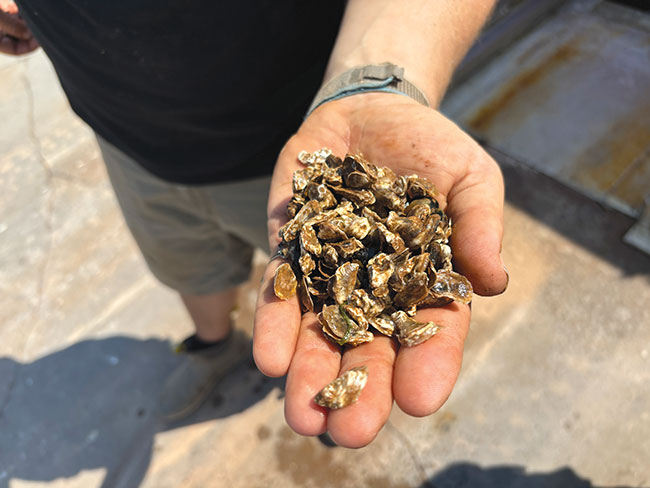
Juvenile oysters at Fortune Oysters farm. Photos: Seyitan moritiwon
Oysters don’t have any kind of adaptive immunity.
Unlike vertebrates that have a defense mechanism which can remember and destroy disease-causing substances, if oysters can’t fight off infection and they get re-infected another time, it’s a whole new infection for them.
In recent times, Atlantic Canada has been plagued with diseases affecting oysters. The Canadian Food Inspection Agency (CFIA), an organization that conducts food safety investigations, confirmed the presence of two oyster diseases, MSX and Dermo, in New Brunswick; Dermo in Nova Scotia; and MSX in Prince Edward Island. And the shellfish industry in P.E.I. says the government is moving too slowly in finding a solution.
Rod Beresford, an associate professor at the biology department at Cape Breton University, sheds some light on these diseases and their impact on oysters. He has a PhD from Dalhousie University in biology, studying the environmental parameters of H. nelsoni in C. virginica.
Beresford is part of a team in Nova Scotia that’s working on tackling the disease in the province. His lab can test for:
1. Haplosporidium nelsoni MSX (Multinucleate Sphere Unknown X) disease
Haplosporidium nelsoni is a spore-forming protozoan affecting Crassostrea virginca (Eastern oyster) along the East Coast, U.S.A. and Atlantic Canada. Infections also affect Crassostrea gigas in Japan, Korea, California and France.
The complete life cycle of H. nelsoni is unknown. What and how the parasite moves around and what the drivers are is unclear. It’s very sporadic with where it shows up, Beresford explains.
He said there have never been direct laboratory transmissions despite different attempts to simulate the disease spread for research purposes. It can complete its life cycle in the absence of oysters or the presence of very small populations of oysters. The disease can cause a 90-95 per cent mortality rate in oysters.
“We really don’t know if, in fact, it’s a true oyster parasite, or these eastern oysters are a dead-end host, and it completes its life cycle in some other organism that we’ve just not found it in yet, or we’ve not sampled enough to detect it. So that part of its relationship with the Eastern oyster, at least, is still a mystery,” he said.

Oysters can take five to seven years to grow to market size.
2. Perkinsus marinus (Dermo)
Perkinsus marinus is a protozoan parasite of oysters that affects Crassostrea virginica in Canada, and Crassostrea ariakensis, Crassostrea corteziensis and Saccrostea palmula outside of Canada.
Dermo or perkinsosis is the disease caused by this parasite in oysters. It can cause significant mortality– about 50-75 per cent–of both cultured and wild oysters. It can be transmitted from oyster to oyster, contaminated water and contaminated equipment. Infected oysters may show signs of no active feeding, gaping, and shell valves are slow to close when out of the water.
Perkinsus marinus seems to have a much more predictable migration to the north with warming water. Beresford said it’s unclear how long it’s been in Atlantic Canada.
“We don’t know if Perkinsus spread into the region recently or is now just present in an abundance where it can be detected,” he said. Perkinsus has the potential to spread more quickly in the region as waters warm up, Beresford said.
3. Haplosporidium costale (Seaside organism)
Haplosporidium costale affects C. virginica from Virginia to Maine and throughout Atlantic Canada. It’s also been reported to affect C. gigas on the West Coast of the U.S.
It’s found in high-salinity waters (more than 25 psu). Prevalence of H. costale is usually less than 20 per cent, hence a low oyster mortality risk. Beresford said the parasite kills, but not as quickly as MSX. They keep an eye on it, but it doesn’t have the same devastating effects as the other two.
The life cycle of H. costale is unknown. However, studies state that infections of H. costale are acquired in early summer but do not become detected until the following March.

An oyster farm in Prince Edward Island
Testing for the diseases
Unfortunately, when an outbreak occurs, farmers just see a bunch of dead animals, which is too late. What they can do for those oysters that haven’t been impacted yet is testing regularly. This, however, has financial implications for the farmer.
Beresford estimated that it costs a farmer, on average, between C$35 and $50 per sample (between US$20 and $35), for an animal to be tested. Depending on the number of animals being tested, that can cost up to C$1,000 (about US$695) or more. ”And even that only gives you a certain amount of certainty. If you have a bigger farm, you’re going to have to test more animals to see if it might be there,” he said.
Once these oysters are taken for testing, they can’t be sold anymore because of the destructive testing they have undergone.
One of the ways to test for the parasite is a DNA test called the polymerase chain reaction, or a PCR test. The lab technician opens up an oyster and takes a tissue sample that includes the gill and digestive gland. They extract the DNA, and then run this test, looking for that small fragment of DNA that fits into the parasite.
Another way to test is to take a slice of tissue from the oyster and place it on microscope slides, to be examined, looking physically for the parasite in the microscope. Haplosporidium costale and MSX look almost the same in a microscope. So that DNA test to differentiate them is needed.
Once an outbreak on a farm has been reported, the CFIA mandates a stop in trading or transferring.


Biosecurity in Alaska
These diseases aren’t known to affect farmed oysters in Alaska. And that’s mostly because of the measures these hatcheries have put in place, said Jeff Hetrick, director of the Alutiiq Pride Marine Institute.
The institute is a tribally managed marine research facility located in Seward, Ala. Its research focuses on enhancing the use of mariculture techniques in Alaska and the Pacific Northwest.
Hetrick is also a member of the Alaska Shellfish Growers Association and has operated an oyster farm in Prince William Sound. He said the lack of disease presence in the region could also be attributed to the colder waters in Alaska.
He said the Alaskan industry has pretty strict regulations for transporting shellfish. “We can’t just throw them anywhere. They go back to the region they came from. So if they were to happen to have some sort of disease, it’s not going to spread to different regions and be localized. If it’s there, then we’re not magnifying it by sending it elsewhere,” he added.
They have a standard operation where they disinfect the exterior of the shellfish and keep them isolated when they receive them, document them, and observe them, ensuring that the same tools are not used between multiple tanks and stocks.
In Alaska, they raise the Pacific oyster, which is non-indigenous so they don’t have any wild stocks. “You can’t go to a beach and find a Pacific oyster. It all has to be through a cultured system with hatcheries. Thereby, it’s a lot more control,” Hetrick said. Whereas on the East Coast, when you have wild stocks that get diseases or a cultured stock, and they interact, and they spread, it goes to the population.
Hetrick also said there’s a lot of separation between farms and operations in Alaska, where most farms are about 40 miles away from another farm. So if there were an epizootic or an outbreak, it’s very unlikely that it would attract them.
In addition to having a good pathology department that they work hand in hand with, Hetrick also said they’re on alert because they understand that things are changing. “It’s worked so far,” he added.
More research
In Nova Scotia, Beresford and his team have done some work that has shown that putting oysters in the right environmental conditions, changing temperature, and salinity regularly seems to allow oysters to survive infection.
“We have to do it on a bigger scale, but we have some pretty solid evidence to show that in the right environment, oysters can sort of outrun the parasite,” he said.
Beresford thinks using suspended culture allows the oysters to survive. Suspended cultures happen when oysters are placed in suspended cages with bags inside, to hang below the water’s surface continuously. This causes the temperature and salinity to change a lot. He said their survival could be
demonstrated, on a much larger scale and is proposing that it be done for the Bras d’Or Lakes in Cape Breton, Nova Scotia.
“With the temperature and salinity changing fairly frequently, the oyster can survive that, where you’re a single-celled organism, it’s going to be really tricky for your little, tiny membrane to buffer you from that which is going to result in damage to the parasite,” he said. If the parasite is damaged, the oyster can mop it up.
Other than the obvious need for funding to make this happen, he’s asking the government to make the regulatory process smoother.
The other option that’s worked well in the United States has been in developing oysters that show resistance to infection. After an outbreak has occurred, the
survivors are taken and bred with the anticipation that their offspring carry those genes that allow them to survive the infection.
Hetrick agrees. He said within the last decade, the amount of technology in biomedicine that can be applied can select for resistance a lot easier than multi-generational exposures.
“I think our response time as an industry and as a profession would be much quicker now when we use those tools that are available,” Hetrick added.
Source: Hatchery International. Original article available here.
Recent News
This article was written by Nancy Russell and originally published by CBC News on August 26, 2024 at 6:00AM ADT.…
This article was written by Shane Ross and Nancy Russell and originally published by CBC News on August 21, 2024…
This article was written by Lisa Jackson and originally published by Global Seafood Alliance on August 13, 2024 at 7:13PM…
This article was written by Stephen Brun and originally published by CBC News on August 13, 2024 at 7:13PM ADT.…
This article was written by Sheehan Desjardins and originally published by CBC News on July 29, 2024 at 6:00AM ADT.…
This article was written by Victoria Walton and originally published by CBC News on July 25, 2024 at 2:47PM ADT.…
This article was written by Kevin Yarr and originally published by CBC News on July 24, 2024 at 11:07AM ADT.…
This article was written by Stephen Brun and originally published by CBC News on July 24, 2024 at 6:25PM ADT.…
This article was written by Wayne Thibodeau and Stephen Brun and originally published by CBC News on July 22, 2024…
This article was written by Stephen Brun and originally published by CBC News on July 21, 2024 at 5:46PM ADT.…